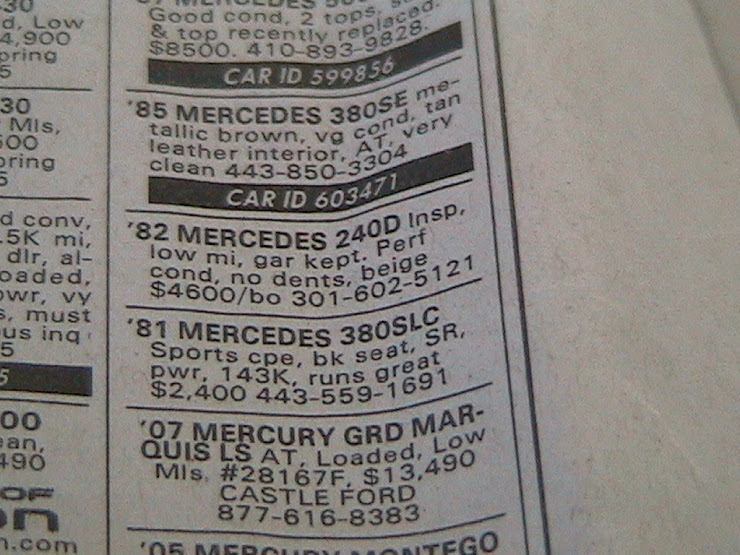
The million-mile car

The million-mile car
Her name is Madeline.

Sunday, March 27, 2011

Viscosity

Society of Automotive Engineers "W" system chart for oil viscosity
Fill up at Mill Valley B-100
$4.15 / gallon
mileage 182070

Its a cold end of March for the Eastern Seaboard, but despite the chill in the air my duties called me to drive to the DC area and spend the day outside with a video camera.

Madeline has been leaving puddles of oil behind her front passenger side tire, and last time she was in to see Dr. Doug he said that she'd at one point run nearly dry of oil.  She takes a special diesel oil, 15W40.  So today started with a quest for 15W 40 oil here in Baltimore.  Checked first at the Royal Farms in Hampden, where the face of everyone standing in line at the cash register snapped in my direction when I came through the door.  You get the feeling that place is the nexus of Hampden's street life.  The Farm Store only had 5W30 and 10W40.

Next, I "excuse me sir"-d the elderly gentleman fixing a screen in the back of Sirkis Hardware.  Same deal,  only 10W40 and 5-something.  Up the street at the Mieneke up the street, the girl at the cash register clued me that i'd have have to go to Advanced Auto Parts at 20th and Howard.

At Advanced Auto Parts, a young black clerk with a fanciful neck tattoo was very helpful.  Turned out that 15W40 is only available in gallon jugs-- $15, please.  I fear that I may actually need that much!  Out in the parking lot, I popped the hood and took stock.  I'd put a quart in a few days ago but thought she might need more.  When I removed the cap to the crank case, there was a steam/smoke emanating from it, and I muttered aloud "That can't be good", which attracted the attention of a large, friendly black man.  I fired up the engine, and we looked at it, determining that it was a head gasket issue.  I didn't add any oil after all, since the dipstick showed "full".  And the big friendly guy assured me i'd have no problem driving to DC and back before getting it fixed.  Then he asked if I was interested in selling the car.  I explained that she was a special case who ran on biodiesel, and that I was documenting my experiences with her.  He looked at me quizzically and walked away.

A little research on why diesel engines need 15W40 revealed that that designation refers to starting temperatures in Centigrade, the number followed by "W" referring to the starting temperature in Winter and the other one referring to starting temperature when its... warmer.  And all that time I thought the W meant "weight".

Turns out the viscosity of various types of oils varies by temperature, and the Society of Automotive Engineers created the "W" system to refer to oils by temperature range.

The wonders of Glycerine

 Cleanser, fuel, food sweetener-- glycerine is a by-product of the biodiesel creation process.  I am buying everyone in my family glycerine soap for Christmas.

Saturday, November 27, 2010

of Caps and Keys

PetroDiesel Fillup # X *
Gas station on 340 in Virginia outside of Harper's Ferry
11/25/10 about 7 pm
B ZERO $15.00@ $3.19/gallon- about half a tank
Odometer: approx. 180,300


Still haven't replaced my gas cap since last fill-up. Luckily, there is a cover to the gas tank. But I worry about condensation especially in the cold weather.

I HAVE been attending to the needs of the car, but have been pursuing a different problem. You see, a car of Madeline's vintage can only start with a special key. In fact, this princess has TWO keys. The one for the driver and the one for the valet. The valet key can't open the trunk or the glove box. The driver's key can open it all.

I own only one copy of that special driver's key, and it is worn nearly to a nub. Every time it is used, a little more gold dust is created around the ignition switch. To get a copy of this key from the dealer requires me to produce the car registration and -- did they even want the title?

I took the key into a local locksmith and he tried to make me a copy but no go. One of the two keys he cut was able to open a door, but the ignition and the rest, not. He said the key was worn out. I still have a copy of the original valet key. That's now going on the key ring for everyday use and I'll just have to keep the driver's key on the same ring. So no backup at home except for that door only key.

So, the to-get list are now two items: Gas Cap, key.

(X= all the non-bio fill-ups since I bought the car, up to Bio-diesel Fill-up #4 when I start tracking both kinds of fill-ups)

Thursday, November 18, 2010

Power to the cage!

Biodiesel Fillup #4
Biodiesel Co-op Pump @ Mill Valley
11/17/10 5:38pm
B31 13.290 gallons @ $3.60/gallon
Odometer 180,002
Notes: Lost gas cap

Thanks to daylight savings time, it was already dark when I pulled up to the bio-d pump at the Mill Valley Farmers Market last evening after work. Luckily the pump cage had handy-dandy motion-sensing lights installed, so I was able to swipe in and get my fuel. Some thoughtful person has provided industrial grade paper towels and medical-style blue gloves for protection from biodiesel's famous solvency, but I didn't really need them. I was careful not to spill any of the paint-dissolving substance on my car's paint job.

The Mill Valley Farmers Market is located in a repurposed red brick mill building at the entrance to Baltimore's cross-town expressway, 83. Recently re-christened as Mill Valley General Store, the building houses several vendors selling locally produced food, gardening supplies, condiments and herbs, among other things. http://millvalleygeneralstore-cheryl.blogspot.com/
The building's owners allow the Biodiesel Coop the use of an area next to the building for the fuel pump cage.

Until recently a welder rented the basement of the building, and the bio-d coop was able to use the electrical service provided for that business for the tiny amount of power needed by the fuel pump and card payment system. With the departure of that tenant, there have been some issues with the electrical delivery to the pump cage. The coop is looking into options for the approximately 75 cents a month of electricity that the set-up requires. The ever-resourceful members of the coop have been discussing it on the listserv- here are some ideas:

- pay Mill Valley $5.00/mo for use of an extension cord.
- mount a truck battery in the cage with a small Radio Shack 300 W 110V Inverter.
- invest in a small marine grade solar battery trickle charger.

The solar option may not be not feasible because of the lack of sun at the Mill Valley location. The other ideas, well... stay tuned.

And as a postscript--
While the pump is not located in one of Baltimore's worst areas by a long shot, it is in an industrial part of town where there is not much foot traffic. So after my fillup last evening I hurried away, forgetting to replace my gas cap. Doh!
Hope the low temperatures don't create condensation inside the tank before I can replace the cap.

Wednesday, October 27, 2010

Wake up and smell the biodiesel

Often when I tell people that my car runs on biodiesel they'll ask if it smells like french fries.  Lots of people know that there is a way to run a car on waste vegetable oil, but they are not as aware of the availability of processed biodiesel that can potentially fuel any diesel engine.  This is what we pump at the Baltimore Biodiesel co-op.

Biodiesel is delivered either as 100% or in biodiesel/petrodiesel blends. 

  • 100% biodiesel is referred to as B100, while
  • 20% biodiesel is labeled B20
  • 5% biodiesel is labeled B5
  • 2% biodiesel is labeled B2


 Most of the biodiesel available today comes from soybeans, which can lead environmentally conscious people to argue that using food as a machine fuel contributes to world hunger.  However there are lots of schemes out there to create biodiesel from non-food sources- algae, fungi, and, my favorite, coffee grounds.

Abstract Image


NYT article on making biodiesel from coffee grounds:
http://www.nytimes.com/2008/12/16/science/16objava.html

Food Chemistry article on biodiesel production from coffee grounds:
http://pubs.acs.org/doi/abs/10.1021/jf802487s

Tuesday, August 24, 2010

Biodiesel fuel shortage

I was able to get 3 sweet smelling tanks of biodiesel from the co-op supply until the day that I was filling up and the pump motor stopped.  I had about 1/3 of a tank in the car.  Posting my experience to the co-op listserv, it was confirmed that the biodiesel tank was empty.  Since the co-op has no reliable source for the fuel, that meant that a search would begin for new sources.  Much discussion of finding a place to locally make biodiesel, including specifics about things like a tank that weighs 30,000 pounds, empty.
This quote from a listserv post quoting an article by Adam Schwartz, President of the Green Guild Biodiesel Coop in the DC area just south.

Nothing Grows from the Top Down: Biodiesel Industry in Crisis June 20th, 2010 As many of you already know, the Green Guild has not had fuel in stock for several months. This has been an long and ongoing saga for this coop, but is also part of a greater crisis within the biodiesel industry. In the past few years, big biodiesel interests and soybean lobbyists have consolidated the biodiesel market and set up regulations that make it prohibitively expensive for small grassroots producers like farmers, coops and DIYers to make biodiesel. This has resulted in a top down fuel system that has sought to mimic the profitable big oil model and doesn't stop to reconsider heinous things like importing soy oil from deforested zones in Brazil. However, in troubling economic times, when communities should be seeking local alternatives to stimulate local economies, we are stuck in red tape and restrictions based on the old way of doing things. We are stuck with a vulnerable system; by being reliant on a relatively small number of multi-million gallon facilities, we have lost community control of our own energy resources once again. This winter, as the Congress allowed a critical $1/gallon tax credit to expire, the biodiesel industry took a huge hit. Overnight, prices skyrocketed and plants began to close for good, while the crackdown on small local producers has continued. In Virginia new legislation made it illegal to transport vegetable oil without a commercial license, essentially forcing an already marginalized biodiesel community to go completely underground. This all happened despite an organized resistance from biodiesel producers, users and farmers on the ground. And now, in perhaps the most critical moment for alternative fuels, during the BP Gulf Oil Spill, one of the worst environmental disasters of our time, when supply and demand for renewable, local fuel should be at its highest, we are way off track. What would happen if the US government were to allow subsidies for the petroleum industry to expire and we were forced to pay the real cost of oil at the pump?; an estimated $10-15/gallon. There would be hell to pay in Washington, yet we do not demand support for renewables with the same fervor. I think there is an important lesson to learn here: nothing grows from the top down. I believe that the best way to really grow long lasting alternatives to a fossil fuel economy is through grassroots initiatives. As a community-based coop, we have been both a small time producer and a bulk purchaser, giving us insight into both realms of the biodiesel world. Purchasing fuel from big producers via middle men suppliers has been frustrating and difficult. As a small coop we have very little purchasing power in relation to big fleets that blend at a B20 ratio. Additionally, maintaining a commitment to B100 while the majority of the industry is moving backwards has been frustrating, with the National Biodiesel Board focusing support for low blends B5-B20. This past year several of the most critical Mid-Atlantic producers went out of business, and without notice, we were delivered B100 from the midwest that was produced from a beef tallow feedstock. This fuel is of horrible, unacceptable quality, its gel point is at nearly 55 degrees and thus can only be used a few months out of the year without causing serious engine problems. From its inception, a critical goal of the Green Guild has been to develop a local, sustainable fuel supply, and cultivate real alternatives to oil consumption. While our own trial at making fuel was successful, it was not to scale, nor was relying on 100% volunteer efforts a sustainable or equitable model. The Green Guild is currently making arrangements with a local producer/farm to become a dedicated supplier to the coop. This will secure a more reliable supply of locally made, WVO feedstock, biodiesel for the coop while maintaining transparency between producer/consumer for using best practices in sustainability and quality control. While this is more complicated logistically, it is a far better solution towards our local energy sufficiency and a more sustainable solution both economically and environmentally. I want to apologize to all the members and folks who would like to be using biodiesel from the coop right now but let everyone know that we are working through this crisis and are committed to providing renewable, sustainable, local fuel to our members. -Adam Schwartz, President, Green Guild Biodiesel Coop

Monday, July 26, 2010

First tank

It only took, like, two years of hovering, circling and procrastinating, but I finally got my first tank of 100% BIODIESEL fuel into Miss Madeline, my 240 D. All it took was for me to join the Baltimore biodiesel coop for $100 bucks a year, which buys me the privilege to pay $3.90 a gallon at the self serve pump down by the farmers market.

I joined the coop June 5 after attending a membership meeting and giving my check to the treasurer.  While the other members had somehow managed to make the leap of faith and just put their check in the mail, my check was sticking to me, and I couldn't get it sent.  So the treasurer was kind enough to actually take it, in person, and one of the other members volunteered to shepherd me through the process of getting my first tank of biodiesel.

It happened that I'd elected to join during a transitional period for the fuel pump configuration.  The fueling setup is actually quite ingenious, there's a cage with a pad where you swipe your card, plug in a PIN, open the door and fuel up, with the bill automatically deducted from your account online.  But there had been a transition from a land-line modem to a cellular modem and the cellular wasn't working the first couple of times I tried to fuel up.  Luckily, I have learned to set aside some reservoir of patience for using technology the first time.  It only took a couple of trys.

Thanks to the thoughtful efforts of the coop's membership coordinator, I was not deterred by initial obstacles, and the day came that I arrived at the pump, swiped my card, plugged in my PIN, and-- voila- I was pumpin' the BIO-DEEZ right into the old Merc!

The first tank was, by the advice of my mechanic, mixed with about 1/3 petro diesel.  Just to try it out. I was advised that I might experience a lag in performance.  Not sure if that has happened, as the 240 D is such a lumbering beast, especially when going up hills, that it is hard to gauge.

What I like is that it smells- pretty good.  And I don't feel like I am inhaling toxic fumes in the car. I know I am renewable, sustainable, and overall just less destructive to the ecosystem.  I am sure Rudolph D. would have wanted it this way.